
Popular Types of Shipping Containers
Dry Containers
Dry Containers are the most commonly used type of container for transporting general cargo. They are built to ISO standard dimensions, with the most popular sizes being 20-foot, 40-foot, and 40-foot high cube (40HQ). These containers are fully enclosed and weatherproof, making them ideal for transporting non-temperature-sensitive goods. They are suitable for use across various modes of transportation.
20ft Standard Dry Container

A 20′ dry container is used for – as the name suggests – transport of dry cargo. A 20-foot container measures 5.90 metres in length, 2.35 metres in width and 2.39 metres in height. The door width is 2.34 metres, while the door height measures 2.28 metres. The tare weight is 2,300 kilos.
The payload is the maximum loading capacity, and it is 28,200 kg on a 20 ‘container. The cubic capacity of a 20-foot dry container is 33 cubic metres. As a rule, a 20-foot container has a capacity of 11 EUR pallets of 120 x 80 centimetres each.
The 20′ container is the most popular worldwide. It is also the smallest container within the standard dimensions, and it is often used for heavy loads, such as machinery and raw materials e.g., iron or similar used in the building and construction industry. But it is also used for transporting ordinary consumer goods and products.
40ft Standard Dry Container
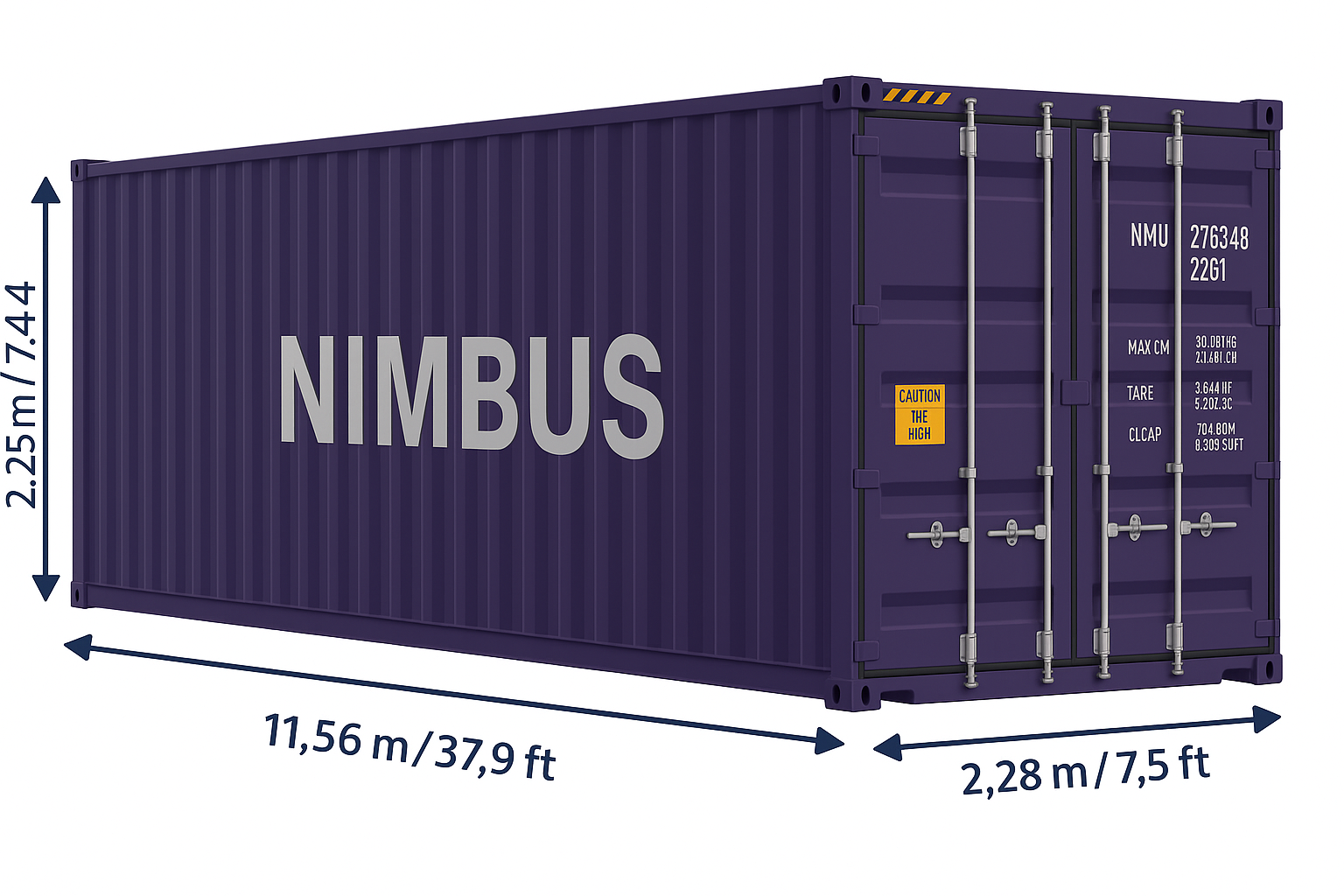
A 40 ’dry container is used for transport of dry cargo, as the name suggests. The inside dimensions of a 40-foot container are a length of 12.03 metres, a width of 2.35 metres and a height of 2.39 metres. The tare weight is 3,750 kilos. The door width is 2.34 metres, while the door height measures 2.28 metres.
A 40-foot container can by default hold 25 EUR pallets of 120 x 80 cm. The payload capacity is the maximum loading capacity, and it is 28,800 kilos on a 40 ‘container. So, it is not much more than a 20-foot container with a payload capacity of 25,000 kilos. The volume of a 40-foot dry container is as much as 67 cubic metres.
40HQ Standard Dry Container

A 40’ high-cube dry container can load 28,620 kilos. With a height of 2.70 metres and an inside width of 2.35 metres, the volume of a 40 ‘high-cube – often abbreviated hc – container is 76 cubic metres. High-cube containers have become very popular in recent years for transporting dry goods via sea freight.
A 40 ft high-cube container is suitable for goods above normal height. Like a standard 40-foot container, a high-cube model is also typically used to transporting ordinary consumer goods. This applies to goods / products such as clothes, shoes, furniture, electronics and the like – all cargo at the light end of the scale, but it is a container with room for a lot of goods.
A high-cube 40 ‘container has a tare weight of 3,900 kilos and a length of 12.03 metres.
45HQ Standard Dry Container

A 45′ high-cube container is one of the largest available on the market. The container can be used for many types of goods but is especially suitable for transporting light voluminous cargo with a maximum height of 2.7 meters.
The inside length of a 45-foot container is 13.56 metres, and the width is 2.35 metres. The container’s door measures 2.34 meters in width, and the door height is 2.58 metres. A 45′ high-cube container has a volume of 85 m3. The container can load 27,600 kilos and the tare weight is 4,800 kilos.
Flat Rack Container
Flat Rack Containers are designed with collapsible end walls, leaving the sides open and the base flat. They are ideal for transporting oversized, heavy, or irregularly shaped cargo such as large machinery, construction equipment, steel structures, pipes, or tracked vehicles.
When not in use, the end walls can be folded down to save space during storage or return transport.
20ft Flat Rack Container

A 20 ‘flat rack container is suitable for transporting heavy loads – especially excessive or otherwise oversized cargo. It can be transport of e.g., pipes and machines. In addition, some flat rack containers are collapsible when not in use.
The 20-foot flat rack container has a tare weight of 2,360 kilos and a volume of 32.7 cubic metres. Due to the lower tare weight than a container with more sides, the flat rack containers can hold more weight. The payload capacity of a flat rack container depends on the model.
A 20 ‘flat rack container has an inside length of 5.70 meters and an inside width of 2.35 meters. The height is 2.24 meters.
40ft Flat Rack Container
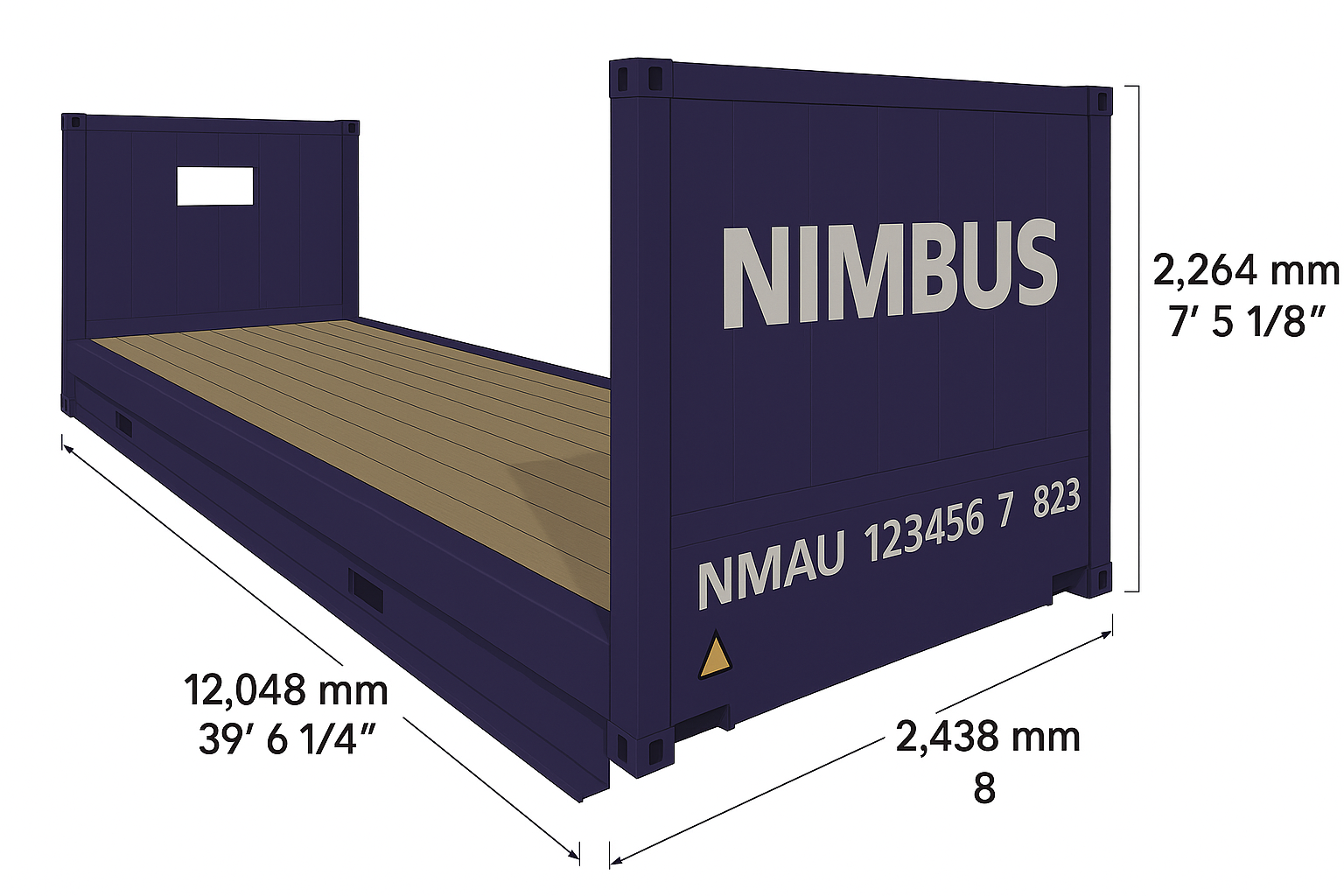
A 40′ flat rack container is suitable for transporting oversized or excessive cargo. It can be transport of e.g. pipes and machines. Flat rack containers of 40 feet have a tare weight of 4,900 kilos and it can load up to approx. 40,000 kilos. 40-foot flat rack has a volume of 51 m3.
Due to the lower tare weight than with multi-sided containers, a flat rack can hold more weight. The 40′ flat rack container has an inside length of 11.66 metres and an inside width of 2.37 metres. The height is 2.28 metres. Some flat rack containers are collapsible when not in use.
Open Top Container
Materials of any height can be shipped efficiently using a convertible top that can be removed to create an open-top configuration. Open-top containers are ideal for cargo that cannot be loaded through the container doors such as tall machinery or heavy equipment which can instead be handled by crane or overhead bridge. These containers are equipped with lashing rings on the upper, lower, and corner sections to secure cargo during transit. They are available in both 20-foot and 40-foot sizes.
20ft Open Top Container

The 20-foot container is also available without a roof – an open top container. Instead of the fixed top, a 20 ‘open top container has a tarpaulin. This type of container is suitable for oversized cargo that cannot get in and out of the usual door opening with a width of 2.29 meters and a height of 2.25 meters.
Cargo in a 20-foot open top container can instead be loaded and unloaded from the open top. Open top containers usually have doors at both ends of the container to achieve flexibility in loading and unloading the contents of the container. The open 20-foot container is suitable for excessive and large cargo, e.g., timber and metal.
The container has a payload capacity of 28,200 kilos, a tare weight of 2,350 kilos and a volume of 32 cubic metres. The top opening of the container is 2.25 metres and a length of 5.68 metres. The inside length is 5.9 metres and the width 2.34 metres.
40ft Open Top Container
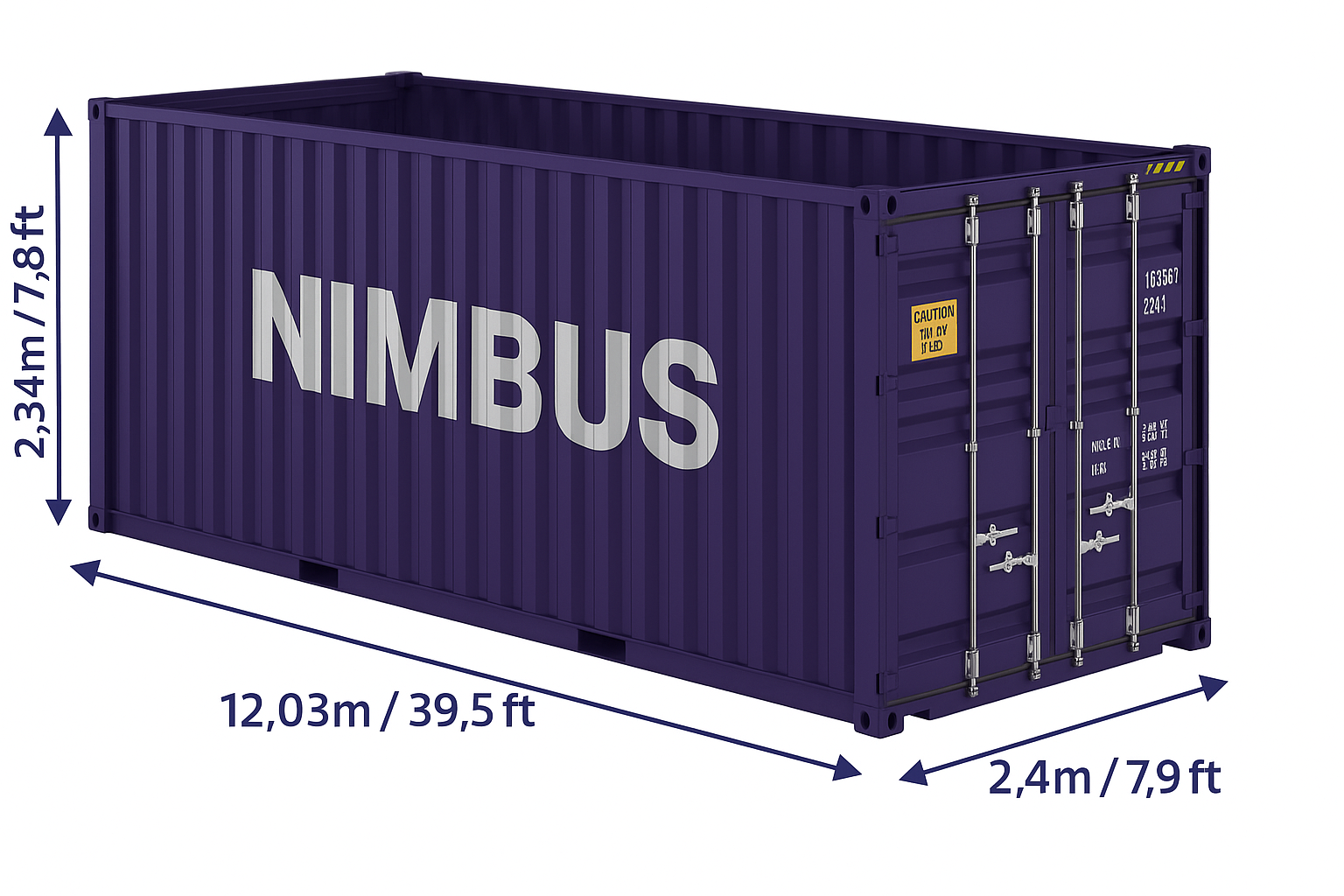
The 40-foot container is also available with an open top – i.e. a container without a roof. Instead of the fixed top, an open top container has a tarpaulin to close the top. This type of container is suitable for oversized goods that can not get in and out of the usual doorway with a width of 2.29 metres and a height of 2.25 metres.
Cargo in a 40-foot open top container can – instead of ordinary loading via a door – be loaded and unloaded from above. Open top containers usually have doors at both ends of the container to achieve flexibility in loading and unloading the contents of the container. The open 40-foot container is suitable for transporting industrial and oversized goods.
The container has a payload capacity of 26,600 kilos. The top opening of the container is 2.22 metres, and it has a length of 11.81 metres.
Refrigerated Container
Refrigerated ISO containers are temperature-controlled shipping units specifically designed to maintain consistently low temperatures. They are primarily used for transporting perishable goods such as meat, fruits, and vegetables over long distances. These containers are typically constructed from weather-resistant ‘Cor-Ten’ steel to ensure durability in various environmental conditions.
20ft Reefer Container
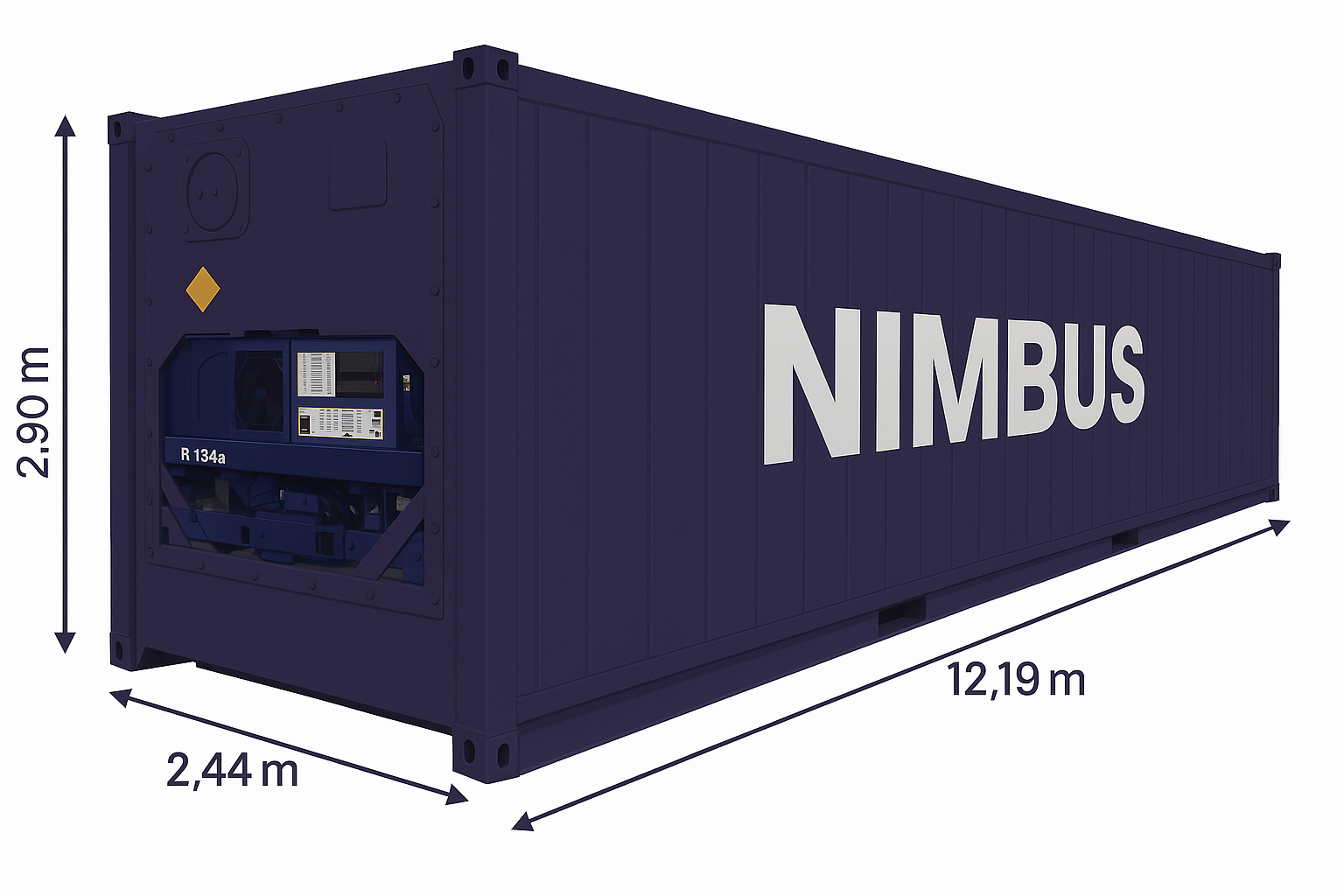
A 20 ft reefer container can load 27,490 kilos. The reefer shipping container can keep the goods at a constant temperature and is therefore intended for the transport of refrigerated goods and frozen products. A reefer container is typically used for transport of pharmaceuticals, fruits, fish, meat, wine, dairy products, ice cream and other frozen goods. The products need a specific temperature to stay fresh.
A reefer container can cool in different zones, part of the container can for example ensure cooling of 5° C, while other areas are for goods that require -18° C. The temperature can be set between -30° C and +30° C. A reefer container requires either electricity or fuel to keep going, and therefore it is more expensive to use this container type.
The container has a height of 2.25 metres and an inside width of 2.29 metres. A 20′ reefer container has a tare weight of approx. 2,900 kilos and a length of 5.45 metres
40ft Reefer Container
A 40 ft reefer high-cube container can load 28,350 kilos. The reefer container can keep the goods at a constant temperature and is therefore intended for the transport of refrigerated goods and frozen products. A reefer container is typically used for transport of pharmaceuticals, fruits, fish, meat, wine, dairy products, ice cream and other frozen goods. The products need a specific temperature to stay fresh.
A reefer container can cool in different zones, part of the container can for example ensure cooling of 5° C, while other areas are for goods that require -18° C. The temperature can be set between -30° C and + 30° C. A reefer shipping container requires either electricity or fuel to keep going, and therefore it is more expensive to use this container type.
The container has a height of 2.50 metres and an inside width of 2.28 metres. A high-cube 40 ‘reefer container has a tare weight of 3,900 kilos and a length of 11.58 metres.